
by Liana Garcellano
Aila Bathan mesmerized when she sang “Pag-ibig sa Tinubuang Lupa” at the launch of the book “Lodi: Stories of Defiance and Resistance” at Balay Kalinaw in UP Diliman last December. Her rendition of the song beloved by activists was poignant, the emotion visible on her face. Before singing, she had introduced herself and guitarist Mikhail “Mikey” Enver Requilman to the audience, and the change in voice was distinct: high-pitched when talking, and low, deep, almost haunting, when singing.
Bathan had a niche audience in that book launch. “My singing isn’t ‘profit oriented’,” she said in an interview one afternoon in January at Corner26, a creative collective space in Teachers Village, Quezon City. Instead of going mainstream like most singers, she walked the non-mainstream path that their parents showed her and her two siblings.
But she expressed no regrets. “The music track I like is political,” she said. “My values, music, and pathway are the same.”
Bathan said she didn’t hesitate to perform at the launch of “Lodi.” She said she was honored to sing for the book’s subjects — the activists Carol Pagaduan-Araullo, Satur C. Ocampo, Bonifacio P. Ilagan and Judy Taguiwalo, who have made upholding human rights and resisting oppression and injustice their life’s work.
Although she plays guitar herself, Bathan roped Requilman in to accompany her song. “You need to deliver the song well, especially with [the book’s subjects] as audience,” she said. I cherish those people because our values align.”
Requilman was equally enthusiastic to perform. He knew “Pag-ibig sa Tinubuang Lupa,” he said, pointing out that activists were singing it before Inang Laya formally recorded it. (The folk duo Inang Laya was formed by Becky Demetillo-Abraham and the late Karina Constantino-David in 1981, during Ferdinand Marcos Sr.’s dictatorship.)
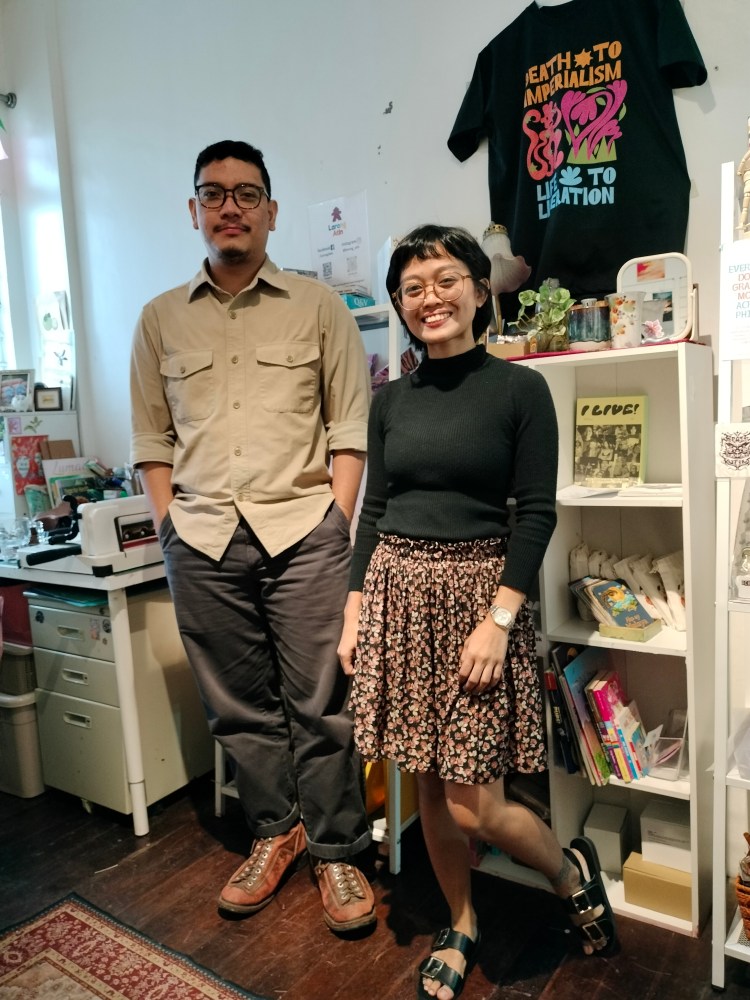
Musical attraction
The launch of “Lodi” was the first professional outing of Bathan and Requilman, who are both members of the Concerned Artists of the Philippines (CAP). Their connection had been instantaneous, Bathan said, recalling that they chatted like longtime friends when they had known each other for less than five months.
“[We] gravitated toward one another. I heard him jamming after a CAP meeting.They were playing Buklod’s ‘Lea,’ which is a favorite song of our mothers,” said Bathan, a sociology graduate of the Polytechnic University of the Philippines, Manila. (Formed in the 1980s, the rock band Buklod sang about social issues including the environment and human rights. It disbanded in 1994.)
The two self-taught artists grew up on music. Bathan said the calm in their house came from music, and from her mother’s infectious humming that got everyone else doing the same. She said her parents introduced her to Buklod, and she was completely taken by their album on nature.
Requilman said he and his eight siblings were immersed in music and raised as feminists. “My parents are music lovers. My dad plays guitar. I grew up listening to RJ100 and NU Rock 107, the ‘Gary Granada Live’ cassette tape, and Joey Ayala before the change,” he said.
Barriers
Artists like Bathan and Requilman aren’t rolling in money, having compartmentalized their lives into art and livelihood. It goes against their stand that artists and their art are inseparable, but their situation clearly illustrates the disjuncture.
Society is not hospitable to creativity, Bathan pointed out. “You’re bogged down thinking of your health, your rent, and food. If you don’t have regular employment, it’s hard to fall sick. [And] you don’t have a pension when you retire.”
For her to continue doing pro bono work in music, she needs a source of income, she said. She did photography as art and livelihood years back, but was derailed by exhaustion.
“It’s difficult to move your art forward with the lack of proper support for creatives,” she said. “Only a small percentage of the population sees art as a proper job. “[Also,] it’s difficult if you’re an artist coming from the ‘bottom,’ compared to one born into money or with an affluent padrino.”
In the same vein, Requilman said a musician/singer can’t live off their craft because no policies exist to protect and compensate them. Music is highly consumed but undervalued owing to the prevalent mindset that being a musician isn’t a gainful profession, he said. The situation, he continued, is muddied by society blaming parents for their child’s “unprofitable” career choice and harping on the supposed embarrassment it brings compared to a choice of career in, say, medicine or law.
Gender bias is an added barrier for women artists, Requilman said. For example, he said, women artists have to look sexually desirable, while “ugly men get a platform.” He recalled that a former girlfriend was told by her management company that she had to lose weight so she could get gigs.
Bathan aired her own frustration: “Society is crazy. I spend time preparing to sing, to deliver my art, and they don’t see [me] as a professional.”
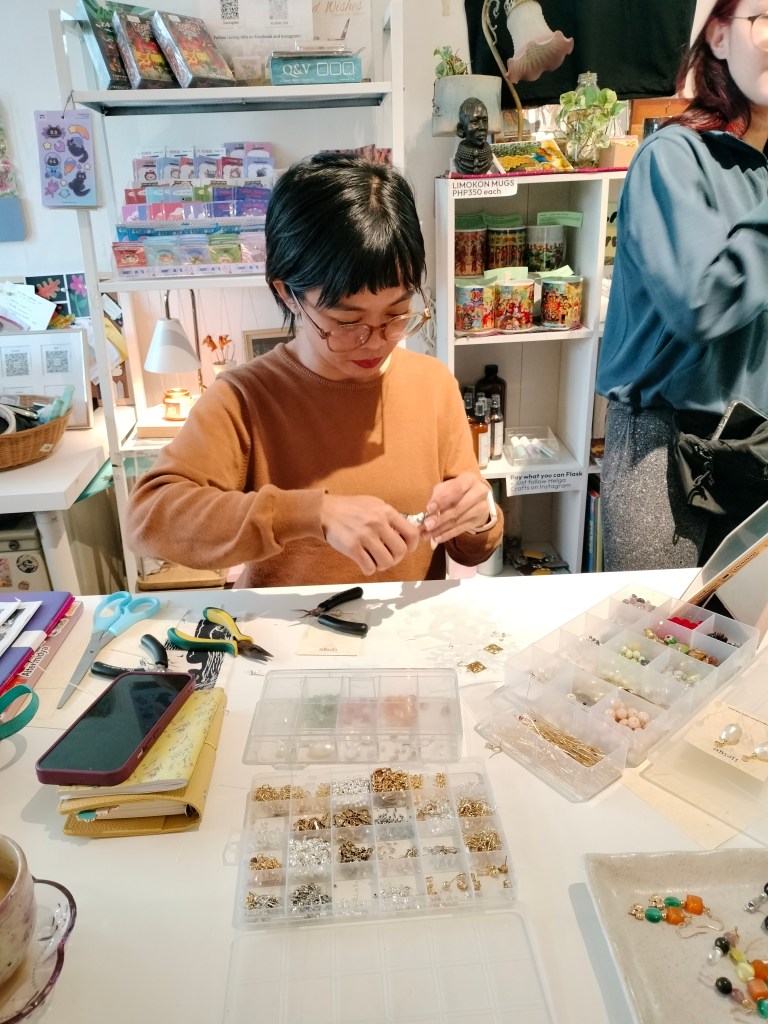
Work mode
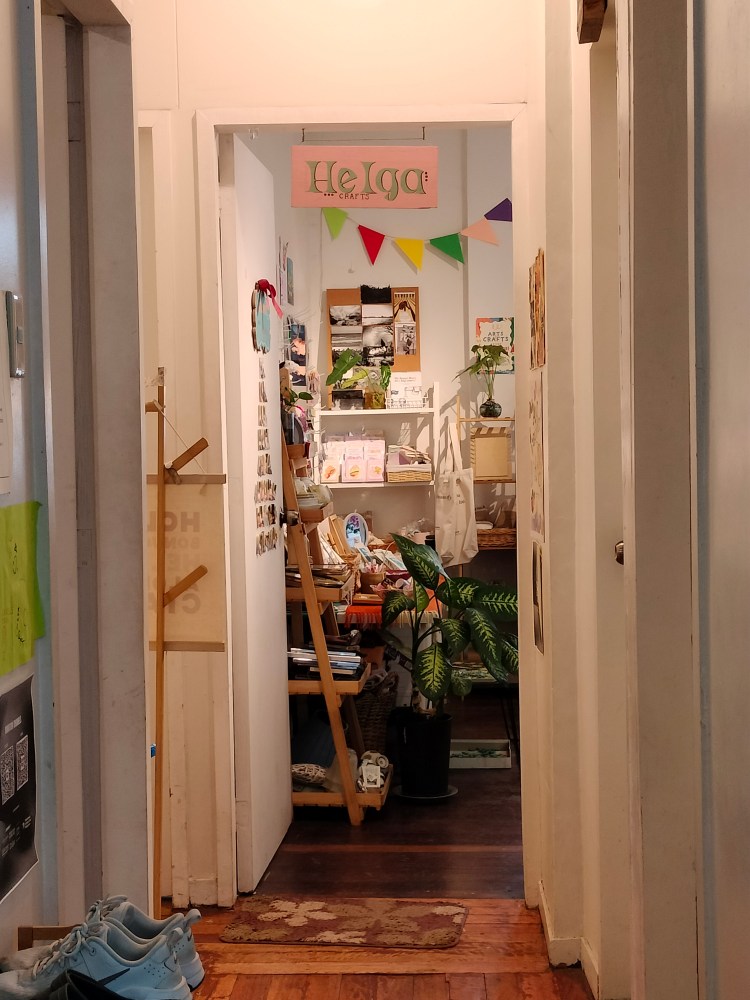
To make ends meet, Bathan sold handcrafted jewelry online and opened Helga Crafts in 2024. It was serendipity: She dreamed of having a space for her craft at the time a customer-turned-friend, Zayra Bulawan, was opening Corner26.
“It was [Bulawan’s] vision to build a small ecosystem where different creatives can work side by side. She invited me to [set up] one of the partner stores. It felt both unexpected and affirming,” said Bathan. (Corner26 has a coffee shop, a flower shop, a portrait studio, and Helga.)
“Being surrounded by people who make art every day has broadened my perspective and pushed me to be braver in trying new things,” Bathan said.
Not wanting to name her shop after herself, she said, she chose Helga, a word that means blessed, and which approximates “Bringer of Light and Grace” (the meaning of her name Aila Grace).
As for Requilman, he said his government staff job supports him and his family. But he qualified that he’s a full-time musician with a day job, and added: “If I’m not a musician, I’d be dead.”
Requilman said his colleagues are used to seeing him lugging his guitar to work, indicating that his indie bands Galaxy Lodge and Dolphin Expressway have rehearsals or invites to perform from indie production outfits (i.e., Furiosa, Pop Scene Manila, and Pop Shoppe by Lilystars Records). They play shoegaze and dream pop music at venues like Mow’s Bar and Unknown13 Pub in Quezon City; Saguijo Bar and Mang Rudy’s in Makati City; or Hangar 18 in Pasay City.
‘Free the artist’
CAP is a nationwide organization of artists, writers, and cultural workers campaigning against censorship and defending freedom of expression. It originally began as the “Free the Artist, Free the Media” movement founded by the firm director Lino Brocka in 1983 as a protest against the dictatorship’s restrictions on the media and the arts.
Bathan joined CAP in 2022 and became active only in 2023 because of a health condition that rendered her voice a register lower. Her doctor advised her to refrain from singing for three years but she recovered in a year’s time, except that now she sings only at CAP events, wanting her performances, she said, to align with the organization’s development.
She heads CAP’s multisectoral committee and brings together artist-members and other sectors of society, such as workers and fishers, through immersion programs.
The idea of joining CAP was broached to Requilman by his band mates, who wanted to connect with progressive groups and write about developments in the country. But in the end, it was only Requilman who signed up: “I wanted to be involved in the cultural movement within my discipline of art.”
A mass communication graduate of the Pamantasan ng Lunsod ng Muntinlupa, Requilman said he liked the sense of belonging, of feeling grounded, and more of himself as a musician. “People tell me to write love songs to become famous. My songs are love songs: They talk about the material conditions, of how to make a relationship work and last,” he said.
Intertwined
Bathan and Requilman’s music journey embodies art and society’s tenacious intertwinement. It’s the art without the ego or the spotlight separating performer and audience. It’s the art in which, Requiman contends, community immersion programs enhance the reciprocal learning: to gain an understanding of others’ struggles while the communities are exposed to art and learn to tell their stories.
Music connected Bathan and Requilman, and their politics sustained their professional relationship. Requilman best summed up their belief: “It’s hard to subscribe to manufactured music promoted in all platforms. Music must speak to you and describe the alienation and class struggle.”
For the two, the personal is political. “As long as there’s introspection, a lot can be connected to the material conditions. Empathy is political,” he said.
“When you wake up in the morning, it’s already political. You’re thinking of how you’re going to survive the day,” she said. #
 Women Writing Women