
by Jofelle Tesorio
(The eight months of covering the detention of former Philippine President Rodrigo Duterte have afforded me a ringside view of how personalistic politics is played out on the international stage, to derail justice awaited by the victims of Duterte’s drug war. The following piece contains my observations as a migrant Filipino journalist who reported on Duterte’s trial in the International Criminal Court (ICC) in The Hague.)

THE HAGUE, Netherlands: On the day that the charges for crimes against humanity hearing for former Philippine president Rodrigo Duterte was supposed to start, both the members of the Duterte family and the families of the victims of Duterte´s brutal war against drugs are hoping for a resolution. His supporters demand that he should be released while the victims demand that the charges be confirmed so Duterte can stand trial.
The confirmation of charges for Duterte refers to a hearing that is a part of the pre-trial process at the ICC. Originally scheduled from September 23-26, 2025, it was postponed to give the pre-trial judges the time to weigh in on the request of the defense to halt the proceedings, citing the unfitness of Duterte to stand trial “as a result of cognitive impairment in multiple domains.” Because of this, the defense asked the Pre-Trial Chamber to “adjourn all legal proceedings on Duterte’s case indefinitely.” So far, there is no date set yet for the confirmation of charges.
¨We are so sad na naantala. It’s better for the process to be faster than this. Six months na siya nasa loob. So, I think, pwede na sana. He will be released… interim release, okay na sa amin. And besides, Rodrigo said he is accepting everything. Whatever comes to him, he’s accepting it. Okay na daw siya. Parang may acceptance na siya,¨ said Duterte’s former wife Elizabeth Zimmerman, after a visit on September 23, 2025, with her granddaughter Isabel Duterte. (We are saddened by the delays in the process. It should have been faster than this. He has been detained for six months. I think he could have been released temporarily. We are fine with that. Rodrigo said he is okay. He seems to have accepted it.)
The ICC judges’ display of professional demeanor greatly contrasts with that of the Dutertes and their supporters who came to the Netherlands from all over Europe to visit him at the ICC prison in The Hague. On March 11, 2025, Duterte was arrested in Manila by Interpol, and he arrived in The Hague the next day.
Since then, members of the Duterte family have been giving regular updates to their supporters. But recently, the Dutertes were asked to refrain from publicly having their conversations with the former president because they run the risk of losing their visitation rights.
For the supporters, it is important for them to get updated, not just to assure them that Duterte is well, but also because they need to post something on social media. Every update means online content is shared and re-shared by their followers on social media, with a chance that the posts will be reported by the media.
Duterte’s daughter, Vice President Sara Duterte, said that the order to keep the conversations only within the walls of the ICC detention center came from the ICC itself. However, the Dutertes somehow defied the order. They still speak to their supporters, although this time, it is limited to “he is okay…” or that he is in high spirits upon seeing them. Early on, Duterte’s family members take turns visiting him. Money is not an issue, they said. “May mga trabaho kami (we all have jobs)” was the response of the VP when asked how they finance their visits and pay the lawyers´ fees. She also mentioned that her father’s current partner, Honeylet, has several businesses. The lawyers’ fees, by some estimates, assuming the current rate of an international lawyer at ICC, can run to millions of euros. Sara Duterte maintained that she was not privy to the fees because the agreement is between her father and lawyer Nicholas Kaufman.
Lawyer Kristina Conti, who represents numerous victims’ families, described Duterte’s detention in Scheveningen Prison as a bittersweet moment for those seeking justice. She remarked—sarcastically—that the Dutertes’ frequent trips to The Hague seemed as casual as visiting Cubao, as if the Netherlands is just a neighborhood away.
“Very stark na, kay Duterte may nakakapag-update, o ito yung nangyari sa kanya. Parang halos, ginawa na nga nilang parang Cubao lang yung The Hague. Every week, every other week, may bisita siya, may kapamilya. Samantalang sila, yung mga namatayan, saan mo dadalawin? Hindi pa nga nakaburol sa maayos na puntod. Yung mga dating namang nakulong, ang iniisip nila — noong panahon nga namin, hirap na hirap kaming bisitahin at wala kaming pera na mag-supply doon sa nakakulong. Kaya bittersweet para sa kanila na nakakulong na pero naalala nila yung kapamilya nila,” lamented Conti.
(Very stark. With Duterte, someone can update us about him. It’s almost like they’ve made The Hague like Cubao. Every week, every other week, he has a visitor, a family member. Meanwhile, those who died, where will you visit them? They haven’t even been buried in a proper grave. They’re thinking about those who were previously imprisoned. During our time, it was very difficult for us to visit, and we didn’t have the money to supply those who were imprisoned. So it’s bittersweet for those who are already imprisoned, but they remember their family members.)
The Dutertes firmly believe that the former president is a victim of political machinations in the Philippines, even as they accused the ICC of using his case as a tool to remain relevant. They rally behind Duterte, who remains unrepentant by saying, “What I did, I did it for my country.” The supporters fully believe this narrative, and they are using every opportunity to amplify it through social media, where Duterte supporters and content creators thrive in huge numbers.
Actions in The Hague
Despite the postponement of the confirmation of charges on September 23, 2025, Duterte’s supporters and groups that demand accountability gathered in different parts of The Hague to drumbeat their calls.
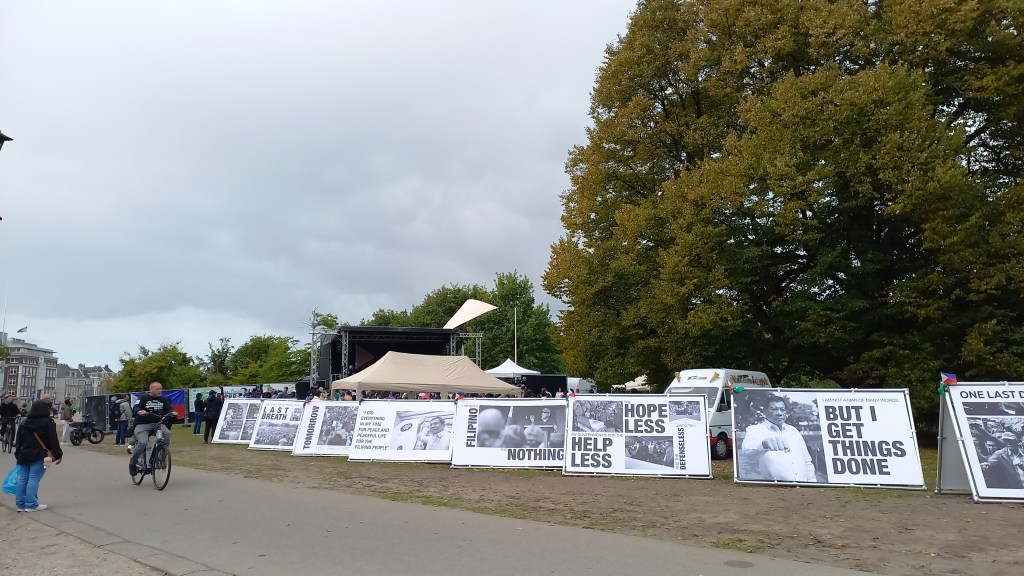
The so-called Duterte Diehard Supporters (DDS), who gather daily outside the ICC detention center staged outdoor exhibits celebrating his achievements and professed patriotism. A stage was also set up on a street named after Ronald Reagan and Mikhail Gorbachev. There, Duterte loyalists sang, danced, and chanted “Bring him home,” turning the space into both a protest point and a fiesta.
In contrast, groups calling for accountability made themselves known through a press conference that featured lawyers and leaders of different Philippine-and-Europe based activist and human rights organizations. They also held their own gathering in front of the ICC and the Peace Palace—the seat of the Permanent Court of Arbitration, which ruled in favor of the Philippines in its 2016 maritime case against China. Composed largely of human rights advocates, migrant activists, lawyers, social workers, and students. The anti-Duterte groups demanded justice not only for victims of the war on drugs, but also for broader human rights violations that Duterte and Sara Duterte were accused of, including corruption and other abuses of power in the Philippines.

Filipino diaspora
The two camps with differing attitudes towards Duterte represent a different makeup of the Filipino diaspora. They have different backgrounds and beliefs. One camp was taken by the power of personalities (not just Duterte, but the politicians and the vloggers who supported him) while the other focused on the issues.
These two groups also had a distinct way of sending their messages. Duterte supporters often gathered over Filipino food—pork dishes like the fatty humba and celebratory lechon—paired with entertainment that includes live music and speeches from prominent DDS personalities and vloggers. These events were regularly streamed on their social media accounts, thus turning even a modest picnic into a public broadcast. At times, the livestreams inadvertently captured moments of infighting and tension among supporters, exposing internal rifts within the group.
The groups calling for accountability strike a more somber tone. Their rallies are occasional and subdued, driven not by personalities or political figures but by their invoked principles and advocacy. When they wish to communicate, they rely on press releases, formal statements and press conferences. They utilize traditional media channels. When they use social media, their messages rarely gain viral traction.
Charges by the prosecution
On September 22, 2025, the ICC released a heavily redacted document detailing the charges against Duterte. The Document Containing Charges (DCC), filed in July, was only made public after sensitive information was removed. It outlines three counts of crimes against humanity, specifically related to acts of murder allegedly committed under Duterte’s administration (2016-2022).
Count One refers to killings that occurred in and around Davao City between 2013 and 2016, during Duterte’s tenure as mayor. The prosecution alleges his involvement in operations carried out by the so-called Davao Death Squad (DDS), which was responsible for 19 incidents of murder.
On Count Two, the prosecution said the murders “were perpetrated by members of the National Network in locations across the Philippines during Duterte’s presidency between around [REDACTED] 2016 and [REDACTED] 2017. The victims were individuals labelled as “high-value,” including for their alleged involvement in drug manufacturing or drug syndicates.”
Count Three involves murder and attempted murder of 45 victims of crimes against humanity in barangay (community-level) clearing operations across the Philippines from 2016 to 2018. ¨The victims were alleged to be ‘lower-level’ criminals. “The physical perpetrators of the crimes in Count 3 meant to cause the victims’ deaths or were aware that their deaths would occur in the ordinary course of events,¨ the prosecution claimed.
Lawyer for the victims, Kristina Conti, clarified that it is inaccurate to say that it is just three acts of murder. She clarified that the process and the terms used at ICC are different from Philippine courts. This is also what the ICC reiterated. The procedure and terms contained in the Rome Statute are entirely different from what the general public, or even lawyers, are normally acquainted with.
¨So, itong document containing the charges ay proposal ng prosecutor kung ano
yung ikakaso kay Duterte. Ito sanang proposal na ito ang pag-uusapan sa confirmation of
charges hearing, kung saan pwedeng si defense kumontra,¨ Conti said.
(This document containing the charges is the prosecutor’s proposal on what to charge Duterte with. This proposal is supposed to be discussed at the confirmation of charges hearing, where the defense can object).
Another counsel for victims and an ICC-accredited lawyer, Gilbert Andres, also explained.
“Count one, crimes against humanity for murder na nangyari nung mayor pa si Duterte. Yung
Count two, crimes against humanity for murder against high value targets, presidente si Duterte, mako-confirm pag ituloy sa trial. At yung count 3, yun din po yung crimes against humanity for murder ng mga barangay clearance operations or in short, ´tokhang´. Ito po yung namatay sa ´tokhang´. Yung Presidente si Mr. Duterte, iko-confirm na ituloy sa trial at yung national agencies na nagpatupad nito. Kaya po, hindi po siya random at systematic, widespread po siya, kaya pasok po siya sa definition ng crimes against humanity under Article 7 ng Rome Statute,¨ he said.
(Count one, crimes against humanity for murder committed when Duterte was still mayor. Count two, crimes against humanity for murder against high-value targets, when Duterte was president, will be confirmed if the trial continues. Count 3 is also crimes against humanity for murder during barangay clearance operations, or in short, tokhang. This one covers those who died in tokhang and the national agencies that implemented it. So, it is not random but systematic. It is widespread, so it falls within the definition of crimes against humanity under Article 7 of the Rome Statute of the International Criminal Court).
(Tokhang is a portmanteau of tok-tok and hangyo in the Cebuano language, or knock-and-plead, but it defines Duterte’s policy of eliminating drug users and petty drug sellers in their homes and communities.)
It is not certain if the defense side has filed a reply since the publicly redacted version was published weeks later after the original date of filing.
Cognitive impairment
On August 18, 2025, Duterte’s lawyers submitted a formal request to the ICC for an indefinite adjournment of proceedings, citing his cognitive impairment across multiple domains. The submission argued that Duterte is unfit to stand trial and that his condition is irreversible, thereby justifying a halt to all legal proceedings under Rule 135(4) of the ICC’s Rules of Procedure and Evidence.
In response, the ICC Pre-Trial Chamber issued an order on August 26, 2025, directing the Registry to submit a detailed report to help adjudicate a request for indefinite adjournment. The Registry plays a neutral administrative and support role to ensure that the Court functions efficiently, fairly, and transparently for all parties involved.
The Pre-Trial Chamber 1 ordered the Registry to submit a report that would include the medical officer’s assessment of the former president´s health management while in custody, outlining all medical care, access, and examination results. It also required an evaluation of whether Duterte suffers from any condition affecting his ability to participate in pre-trial proceedings, including the confirmation of charges hearing, and whether any special measures or adjustments are recommended to accommodate his medical condition during those proceedings.
According to the Registry report, the medical officer reviewed Duterte’s health and recommended adjustments to the court’s sitting schedule to accommodate his condition, with daily evaluations planned during the confirmation of charges hearing. It also transmitted a report detailing the medical care and arrangements provided in detention. The report said Duterte gave consent to this. However, the annexed medical report of Duterte was kept confidential.
The report emphasized that ”the medical officer’s mandate is limited to the oversight of the physical and mental health of detained persons […]”, not determining fitness for trial.
Interim release request
Besides the request to halt all proceedings, the defense has a standing request for Duterte’s temporary release, citing his age and health condition, while assuring that he will not violate the conditions imposed by the Court. The defense also argued that Duterte is not a flight risk and no longer wields power to endanger witnesses and the families of the alleged victims.
The counsel for the victims and the prosecution opposed the request by highlighting recent incidents, including public statements by Duterte’s daughter, which, according to them, “undermine the legitimacy of the Court.”
“For example, on 19 July 2025, Sara Duterte, the current vice president of the Philippines, spoke in front of a crowd in The Hague and was interviewed afterwards. During this event, she repeated the claim that Mr Duterte was “kidnapped” by the ICC and stated that it was “illegal” to bring him to the Court. She also told supporters, supposedly in jest, that she had discussed breaking Mr. Duterte out of the ICC Detention Unit with a colleague. She reportedly made similar comments during a Facebook live stream while in the Kingdom of the Netherlands, allegedly stating “let’s all collaborate on a jailbreak,” the prosecution’s response read.
The prosecution also warned that Duterte’s release would increase the risk of obstruction, citing his desire to return to Davao City, where he allegedly pledged to “double the killings the moment [he] return[s]” as elected mayor. It added that the release “would provide him (Duterte) with greater access to his family and associates and thereby increase the likelihood of interference with the case against him.“

Confirmations of charges
For the confirmation of charges, the hearing is still up to the judges, according to ICC spokesperson Dr. Fadi El Abdallah.
¨It’s about the full respect of the rights of everyone. I do trust that victims want the truth to be revealed. They just don’t want the conviction of a wrong person who was not guilty. They want, if someone is innocent, to be declared innocent. And if he or she is guilty, they are declared guilty. That can be guaranteed only with the full respect of the rights of the defense, the presumption of innocence, including a whole set of rights of the defense, and also the rights of the victims,¨ he said.
Simply put, the judges decide on the charges by the prosecution, the request for halting the proceedings by the defense, and other requests.
¨It is for the judges to decide on the requests that are submitted either by the prosecution or by the defense, or also by the representative of the victims. The judges are the only ones who have the full picture, because as you know, there’s a lot of information that is not revealed publicly, especially if the information is related to the private life of someone, to the private health condition of someone,¨ El Abdallah commented.
The glass building
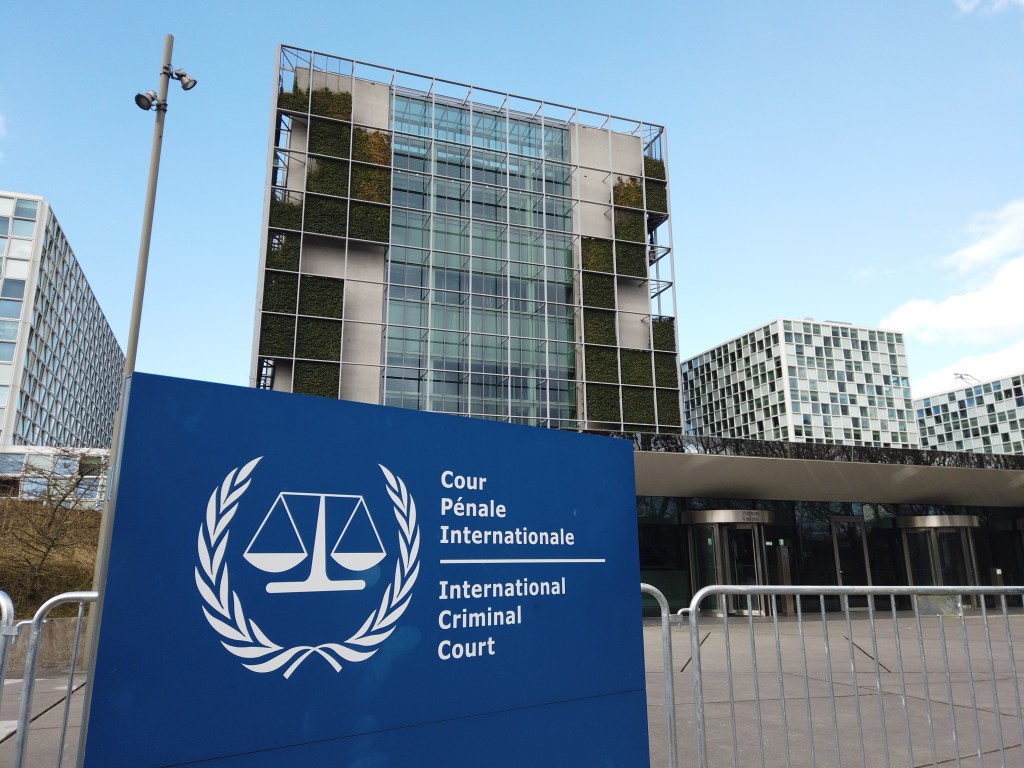
What stands between the opposing groups is the ICC — a tall, imposing glass building, not far from Scheveningen Beach of The Hague. It is the home of ICC, the international tribunal formed to address the gravest crimes that threaten global peace and justice, especially when justice in states fails.
The premises, completed in 2015, were designed by Danish firm Schmidt Hammer Lassen Architects after winning an international competition. According to global architecture and design platform Archello, the ICC’s glass building was designed to embody transparency, justice, and international unity, the core values of the Court. The use of glass and open grid facades reflects the ICC’s commitment to openness, trust, and democratic values. The gardens feature flora from each of the ICC’s 110 member (founding) states, symbolizing cultural diversity and shared commitment to justice. The ICC currently has 125 member states. The most recent countries to announce their withdrawal are Burkina Faso, Mali, and Niger. Past withdrawals included the Philippines (effective in 2019), and Burundi (effective in 2017). South Africa attempted a withdrawal in 2016, but later revoked it. Hungary formally notified its withdrawal on June 2, 2025, and will take effect on June 2, 2026.
Officially begun in 2002, it builds on the legacy of the Nuremberg and Tokyo trials, and later ad hoc tribunals for Yugoslavia and Rwanda.
The ICC, being a court of last resor,t is an impartial one, despite critics calling it political.
¨…trust that there are independent and impartial judges who would apply the law, who would ensure the fairness of the proceedings, the full respect of the rights of everyone, of the defense of the victims as well and will judge only based on the rule of law but also on the evidence that is available to them,¨ said ICC spokesperson El Abdallah.
The ICC maintains that the judges only act on evidence presented, and the spokesperson only answers based on facts and procedures.
As it is, the world watches as the full measure of the ICC’s system of justice is being tested in the trial of former Philippine President Rodrigo Duterte.
 Women Writing Women