
By Maria Olivia H. Tripon
We lost two women columnists. Not that they stopped writing, but they passed on to the great beyond and met their final deadline. Recently, Rina Jimenez-David of the Philippine Daily Inquirer (Jan 11, 1955-Nov 12, 2023) and two years ago, Domini Torrevillas of the Philippine Star (Aug 28, 1940-Dec 28, 2020).
I met Rina in 1987 at the home of Rochit Tanedo, who started the Women’s Feature Service* (WFS) as a project of InterPress Third World News Agency, which opened its Manila office. Rina and I submitted our stories to Rochit, our editor, since there was no email then. WFS had no office yet. Rina came breastfeeding her baby girl. Rochit lured us to her home by offering to cook spaghetti. Only women writers can make work a bonding session like this.
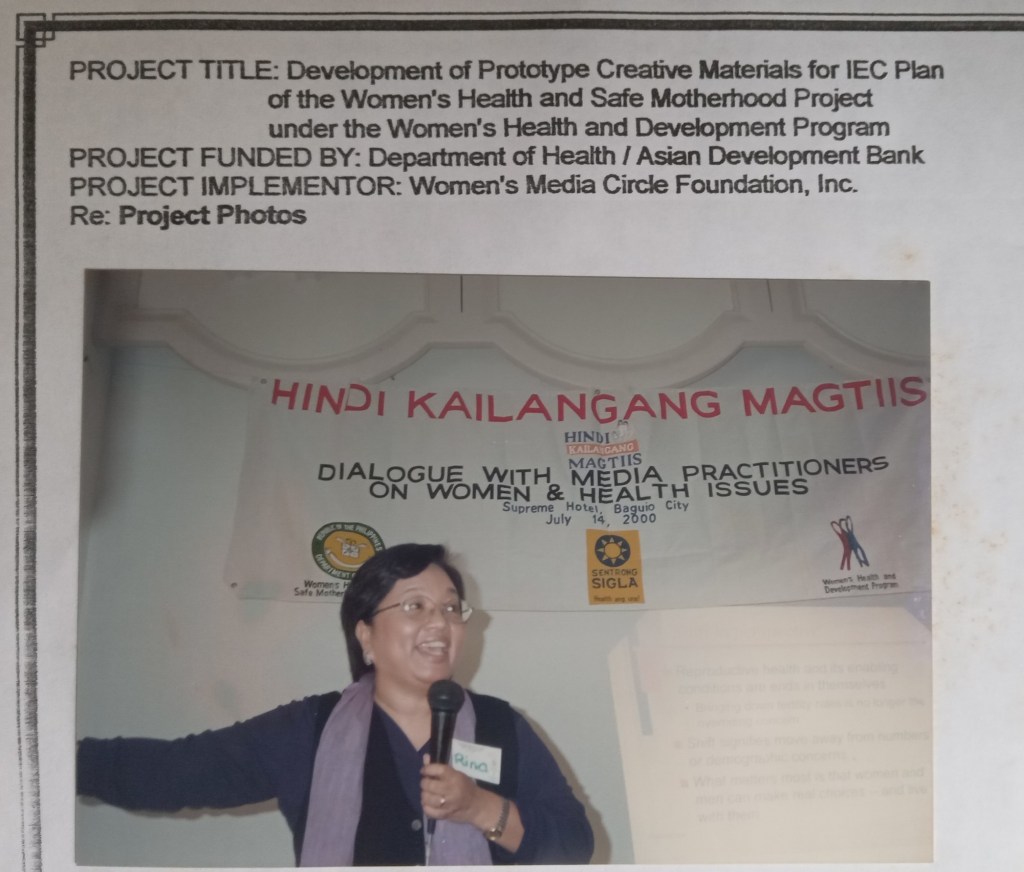
WFS stories were about any issue seen from women’s eyes. “I’m not a feminist,” Rina blurted out. “Me too,” I said. But the more women we interviewed and wrote about, the more we learned about being feminist—the right to reach one’s potential through equal opportunities. And that’s how our becoming feminist began.
Rina’s column “At Large” (1988-2021) in the Philippine Daily Inquirer and Domini’s “From the Stands” in the Philippine Star tackled a lot of issues that impact women’s lives such as the controversial Reproductive Health (RH) bill that took more than a decade to be passed into law.
Rina became a champion of women’s health that she was recognized as Best Columnist in the Global Media Awards for Excellence in Population Reporting by the U.S. Population Institute—she won twice in 1994 and 2004. She also won a fellowship from the John Hopkins University School of Public Health in Baltimore, Maryland. She also got the TOWNS (The Outstanding Women in the Nation’s Service) award for Women’s Rights Advocacy in Journalism in 2013. In 2015, she received the Global Advocacy Award from Women Deliver as one of fifteen journalists focused on the plight of women and girls.

Domini
Domini studied AB English at Silliman University in 1961, and her master’s degree at Northwestern University Medill School of Journalism in Illinois. She was a feature writer and editor of Panorama Magazine of the Manila Bulletin from 1961 to 1987 before joining the Philippine Star. During Martial Law, Domini was among other women journalists subjected to military threats, harassments and intimidation. She was the 1980 Sillimanian awardee in journalism.
I met Domini when she was already a columnist of Philippine Star. I remember picking up her famous sans rival cake that I ordered from her home in Pasig years ago. But we lost touch. When I finally “found” her on Messenger, she said, “Hi Olive. We’ve not seen each other for decades but you’ve been in my thoughts. I miss friends like you.”
In May 2020, I traced Domini in Gingoog, Misamis Oriental, her hometown, where she “retired” with her husband Saeed Daof, governor of the Philippine Red Cross. They moved there in April 2018. “My contemporaries have left or died. I have to develop new friends,” she texted. Aside from missing her friends in Manila, she was saddened by the ABS-CBN shutdown.

I told her that on March 6, 2020, we, her friends were at Miriam College for the Women’s Summit. Pennie Azarcon de la Cruz, my editor, Lisa Garcia of the Foundation for Media Alternatives, my co-author, and I presented our report on women and media. Rina was the moderator. The report was part of the Philippine NGO Beijing+25 report published by the U.P. Center for Women’s and Gender Studies and Oxfam. “I can use that for my column,” she said.
At 80, she was still writing her column. In fact, in her last message to me on June 14, 2020, she asked for more data on the terrorism bill.
That was my relationship with Rina and Domini. As WFS executive director, they were my go-to persons for our projects and advocacies for women. We often collaborated on projects that addressed women’s issues. We would often bump into each other at events of the many women’s organizations in the 90s. In fact, I saw them at the Fourth World Conference on Women in Beijing in 1995. We were proud that other Filipinas like Patricia Licuanan, the late Sen. Leticia Shahani and Ambassador Rosario Manalo held leadership roles at that time.
Rina
As NCRFW (National Commission on the Role of Filipino Women) Commissioner for media, Rina was always with the country delegation to the international review of the Beijing Platform for Action every five years, by the UN Commission on the Status of Women (CSW). Since I was covering for WFS, I was always welcome to their planning and deliberations.
In 2000, I joined the government delegation in their apartment to save on costs. Domini was one of my room mates. I think Rina was there, too. It was actually a big room with many beds. Dr. Amelou Reyes was the NCRFW (now Philippine Commission on Women or PCW) chairperson then. We would walk to St. Patrick’s Cathedral in New York, all bundled up against the cold. There were a lot of goings-on with Filipinas there. Soc Reyes was excited to watch a play on Broadway. While we were trying to call long distance to check on our kids, one woman was checking on her dog!
But the serious job of guarding the gains of the Beijing Platform for Action and its implementation was foremost on our minds, with conservative delegates from Iran and the Vatican, and even Filipinos, parading with Mama Mary’s statue in New York. As usual, there were many contentious issues still in brackets that had to be resolved until the wee hours of the following day.
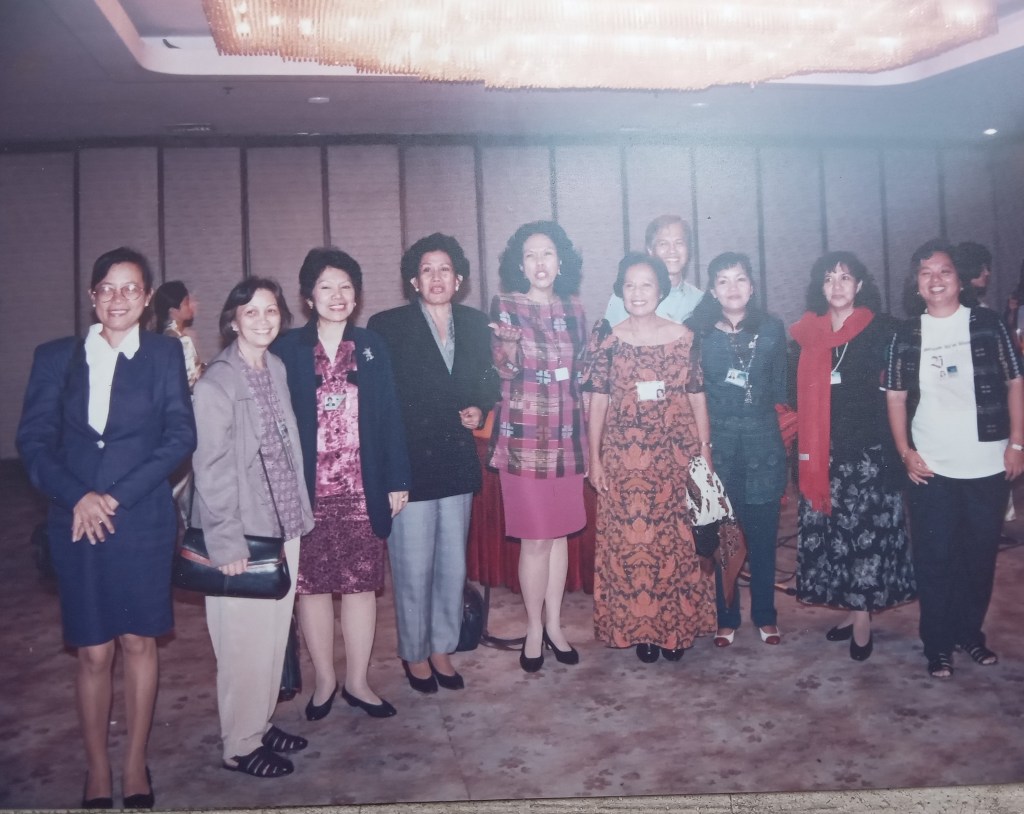
Rina and I had common friends like Pennie Azarcon de la Cruz. They were classmates in UST and colleagues at the Varsitarian, their college paper, as well as members of PILIPINA, a feminist women’s organization. As Pennie mentioned on her tribute to Rina, they would share writing assignments and projects. I’m lucky to be part of their sisterhood. When one of them was too busy with other things, Pennie would pass on a project to me. That’s why in 1998, I found myself with Rina in Kathmandu, Nepal for the regional training on population sponsored by the Population Reference Bureau, courtesy of Pennie’s recommendation. We visited health clinics and training centers for women, similar to those in the rural areas of the Philippines and imbibed regional lessons on health practices.
In 2007, I asked Rina to write for the WFS book project, “Shaping the Women’s Global Agenda (Filipino Women in the United Nations) published by NCRFW with support from UNIFEM. She wrote about Ambassador Rosario Manalo who holds the distinction of being Chair of both CSW (1984-85) and the CEDAW Committee (2005-2006), the first ever in the history of feminism in the UN. “Building consensus behind the women’s agenda” showed the tedious process in navigating consensus. With Rina’s experience with government delegations, she was familiar with the UN procedures and had written the saga of the Nairobi Forward Looking Strategies as an expert.
Reading her piece again on the 1985 Third World Conference on Women in Nairobi, Kenya, I am reminded of the current siege on Gaza. “Day after day the …meetings ended in frustrating stalemates not over issues of gender discrimination or women’s rights, but over such thorny … issues as Zionism, apartheid, the situation of Palestine,” she wrote.
Rina wrote the foreword, “Witnessing a birth” in the 2021 book on the women’s health rights movement, “Lighting the Fire” (published by Gantala Press and Alfredo F. Tadiar Library with a major grant from PROCESS). The book was edited by Florence and Neferti Tadiar and Rina’s foreword gave a background of how the movement was born in the aftermath of EDSA, with President Cory’s conservative view on family planning. The initial gathering of feminist organizations of diverse advocacies led to the gradual increase of support for women’s reproductive health rights which become a movement during the years of lobbying for the RH bill.
The work of Rina and Domini, both of whom have written extensively on women’s health and rights, should not stop with their demise. It must be continued by the women’s movement in the Philippines.
Rina’s last two paragraphs in the foreword are a foreboding of things to come. “…almost a decade after the passage of the Responsible Parenthood and Reproductive Health Law, women’s (and young people’s) reproductive health and rights remain contested territory. The latest surveys show that the number of adolescent pregnancies is not just growing, but that girls as young as 10 years old are increasingly reported to be pregnant, a clear threat to their health and survival as well as of the infants they bear. Sadly, the emergency remains in play…”
Clearly, the work of Rina and Domini, both of whom have written extensively on women’s health and rights, in their twice weekly columns since 1988, should not stop with their demise. This must be continued by the women’s movement in the Philippines for “…the need for reproductive health and rights advocates remains as dire as it was more than three decades ago.”
Writing “30” at the end of a story has been traditionally adopted by journalists. It is Morse Code for “the end.” For Domini, who never stopped writing her column, let me write “80” and for Rina, who still wrote editorials even as her paper ended her column, “68.” Writers will long be remembered for their written work and will remain even after their deaths.
Paalam Rina and Domini. The Kawomenan will miss you. WWW
*The founders of WomenWritingWomen Philippines are formerly writers and journalists of the Women’s Feature Service headed by Olive Tripon.
 Women Writing Women